article
Flexible Ducting for Industrial Drying Equipment: Specification Checklist
Specify flexible ducting for industrial dryers, curing lines and dehumidification equipment using air temperature, heat exposure, airflow, movement and connection geometry.
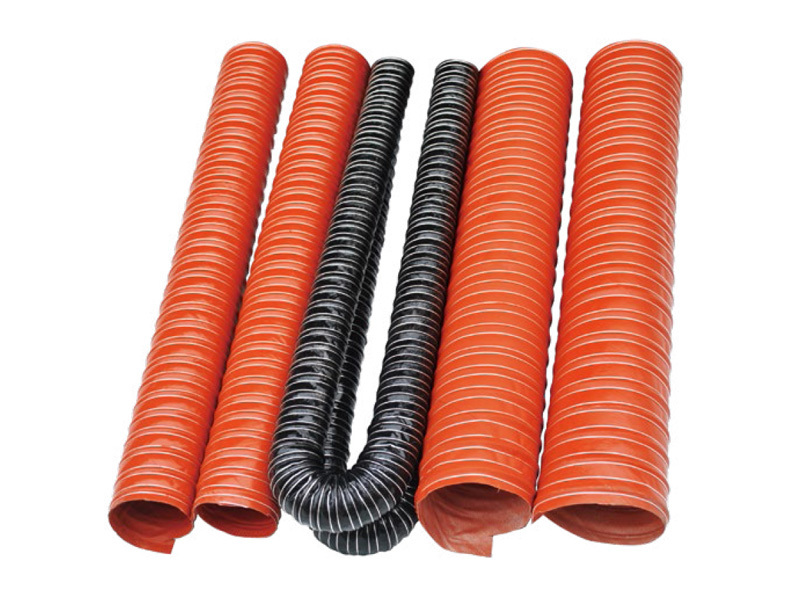
Define the actual thermal duty
Industrial drying equipment can have a normal process-air temperature, short peak events and external radiant heat near an oven or heater. Report each condition separately. The highest catalogue temperature alone does not show whether a flexible duct can serve the complete duty cycle.
Match the duct to the air path
A dryer may need a flexible connection at the blower, heater, moving chamber or exhaust point. Record the airflow direction, fan pressure, duct diameter, required length, bend radius, vibration and available installation space. These factors determine whether a silicone fiberglass duct, insulated flexible joint or higher-temperature construction is appropriate.
Consider insulation and maintenance
Insulation can reduce heat loss and lower the external surface temperature, but it also changes outside diameter and flexibility. Plan clamp access, inspection of the first bend and clearance from hot surfaces. Select a duct construction that can be maintained without forcing a sharp bend or crushing the wall.
RFQ details for custom dryer ducting
A useful enquiry includes the dryer or fan photograph, medium, continuous and peak temperature, pressure, diameter, length, end connection, movement and quantity. A flexible ducting supplier can then assess a custom configuration for sampling or quotation.
Related content
Request a quote
Tell us the medium, temperature, pressure, diameter, length and quantity. Our team will respond shortly.
Thank you. Your inquiry has been received.